What a process cooler does in daily production
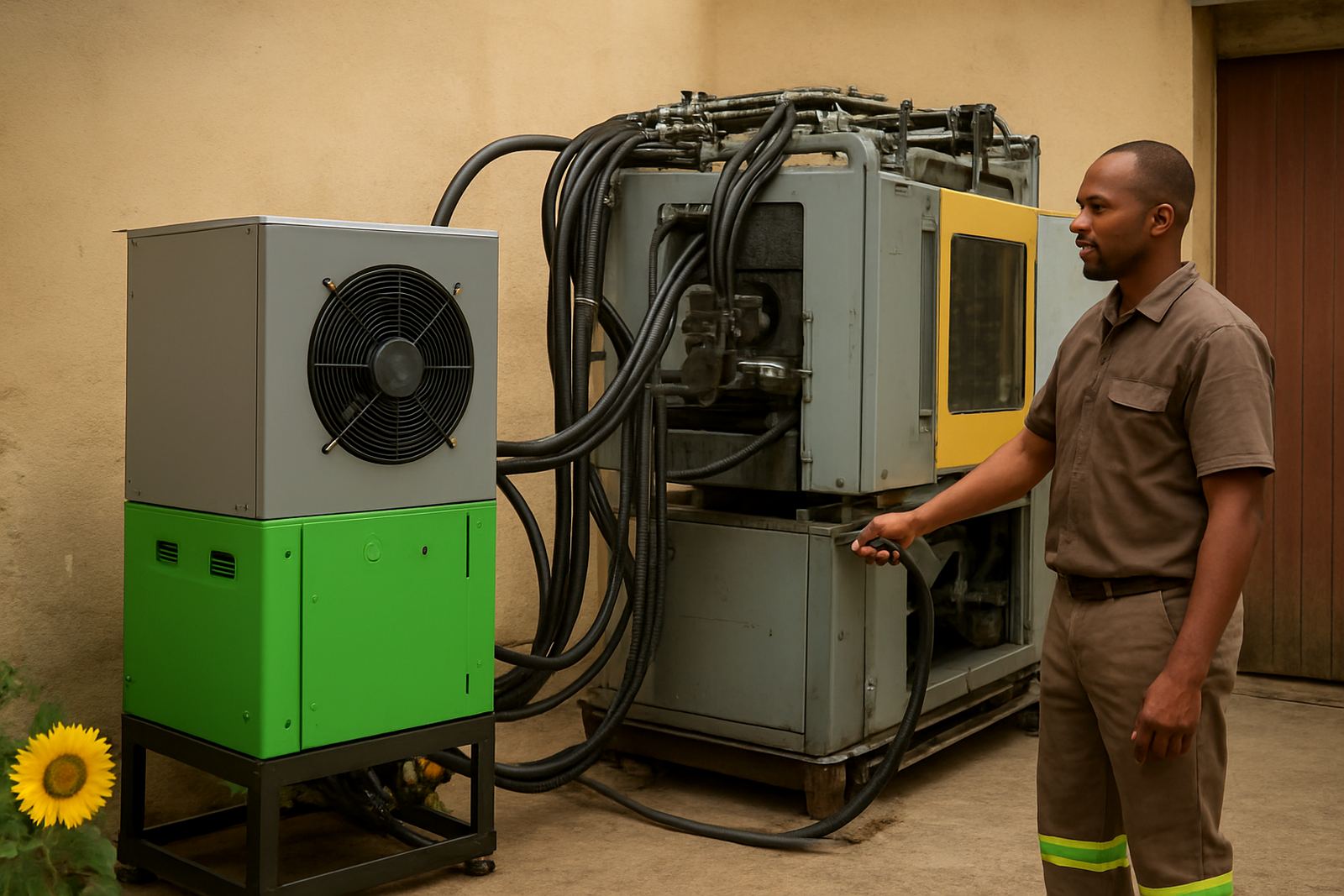
A process cooler is a dedicated refrigeration unit that removes heat from water, glycol or another transfer fluid, then sends that cooled fluid back through your equipment. It is used where product quality, cycle time or machine life depends on a stable temperature rather than a room that simply feels cool. In factories around Newton Park, Struandale, Uitenhage and Despatch, these units are often tied to moulding machines, hydraulic systems, mixing tanks, jacketed vessels and line equipment that runs for long shifts.
Unlike general comfort air conditioning, process coolers are built to handle a fixed thermal load for hours on end, including start-stop production, heat spikes and summer humidity. That matters in coastal Gqeberha where salty air and dust can shorten coil life if the unit is not selected and maintained properly. A good installation also has to cope with load-shedding and supply dips, so controls and protection need to be set correctly.
- Used for machinery, tanks, moulding lines and packaged production areas
- Designed for constant duty and steady outlet temperatures
- Suitable for water or glycol circuits, depending on your process
Size options and build choices for Eastern Cape sites
Process coolers are selected by the actual heat load, not by floor area. We look at kilowatts of heat to be removed, required outlet temperature, ambient conditions and how the load changes through the day. Smaller units may suit a single machine or a compact tank line, while larger skid-mounted systems can serve multiple process points with pumps, controls and fail-safes built in.
Typical options include air-cooled units for sites with enough outdoor space and water-cooled or remote-condenser arrangements where heat rejection needs to be managed differently. Stainless steel housings, epoxy-coated coils and weather protection are worth considering near the coast, especially in Jeffreys Bay and Port Alfred. For corrosive washdown areas, the pipework and fittings must be chosen with care so the unit does not start rusting after one wet season.
- Cooling capacities commonly range from about 5 kW to 300 kW plus, depending on process demand
- Fluid circuits can be water only or a water-glycol mix for lower setpoints and freeze protection
- Controls can include pump interlocks, alarms, high-temperature trips and temperature monitoring
Installation, power supply and refrigerant planning
Proper installation starts with confirming the load, pipe route, power supply and service access. We size the cooler to the real duty and allow for summer ambient temperatures, peak line speed and any future expansion. If the process needs a lower fluid temperature, a glycol mix may be specified to prevent freezing in the coil and pipework. On some sites, that also helps with temperature stability when the load changes suddenly.
Power needs vary by size, but most process coolers require a dedicated electrical supply, lockable isolator and suitable overload protection. Three-phase supply is common on commercial and industrial sites, and the starting method may need to be adjusted to suit the network or generator. Where a refrigerant conversion is planned, we look at low-GWP gas options and make sure the oil, valves and controls are compatible before any work begins.
- Check available electrical capacity, phase balance and generator support
- Confirm fluid type, required setpoint and pipe length before ordering
- Allow space for cleaning condenser coils, filters and pump strainers
What to check before you place an order
Before ordering a process cooler, it helps to have a clear list of process details. We normally ask for the target temperature, return temperature, flow rate, fluid type, duty cycle and whether the load is constant or intermittent. If you are replacing an existing unit, photos of the nameplate, pipe connections and plant room layout are useful. If the old system failed, the reason matters too, because the new unit should not repeat the same fault.
You should also confirm where the unit will sit, how maintenance staff will reach it and whether there is enough fresh air around the condenser. On sites with strict hygiene rules or municipal discharge controls, water treatment and drainage must be checked before commissioning. A little more planning up front can prevent an expensive stop later on when the line is down and production is waiting. It sounds basic, but we see missed details all the time.
- Target temperature and acceptable temperature swing
- Heat load in kW or the machinery specification sheet
- Fluid type, pipe size, length and insulation level
- Power supply details, including generator use during load-shedding
- Indoor or outdoor siting, noise limits and access for servicing
Key facts
| Cooling duty range | Approx. 5 kW to 300 kW plus, depending on process load |
|---|---|
| Temperature control | Typically stable to within about ±1 °C, subject to application |
| Fluid options | Water or water-glycol mix |
| Refrigerant setup | Standard and low-GWP conversion options available |
| Power supply | Single-phase on smaller units, three-phase common on larger sites |
| Construction options | Weatherproof housing, coated coils, stainless fittings on corrosive sites |