Keeping factory cooling steady through load-shedding and heat
In a factory, cooling is usually tied to more than one job. You may have machinery that needs a stable oil or water temperature, process loops that must hold a narrow range, and utility plant that has to keep running even when the weather turns hot or the power cuts out. Around Gqeberha, Despatch and Uitenhage, we see that these systems often work hard through long shifts, salty air and dust from open yards. Once one part slips, production losses follow quickly.
Nvirocool helps factories that need practical support for chillers, cold rooms, pumps, controls and monitoring. Some sites call us for planned maintenance every month, others only when a breakdown hits on a Saturday afternoon. The best results usually come from a fixed service plan, because it keeps small faults from turning into expensive stops. A compressor that is drawing too much current, a blocked coil, or a drifting thermostat can all waste power and strain the rest of the plant.
We also look at how the cooling links to the rest of the site. If a factory has a generator, an unstable supply or frequent starts and stops, the system needs to be set up with that reality in mind. Simple changes like better time control, proper sensor placement and clean airflow around condensers can make a real difference without a full replacement.
Typical equipment found in Eastern Cape factories
Every site is different, but most factory cooling sets fall into a few common groups. Some are built around packaged chillers, others use split systems, water-cooled units, glycol loops or dedicated cold rooms for ingredients and finished goods. Older plants may still run on refrigerants that are costly to keep compliant, while newer systems often need conversion planning to reduce emissions and future service risk.
- Air-cooled and water-cooled chillers for process water or machinery cooling
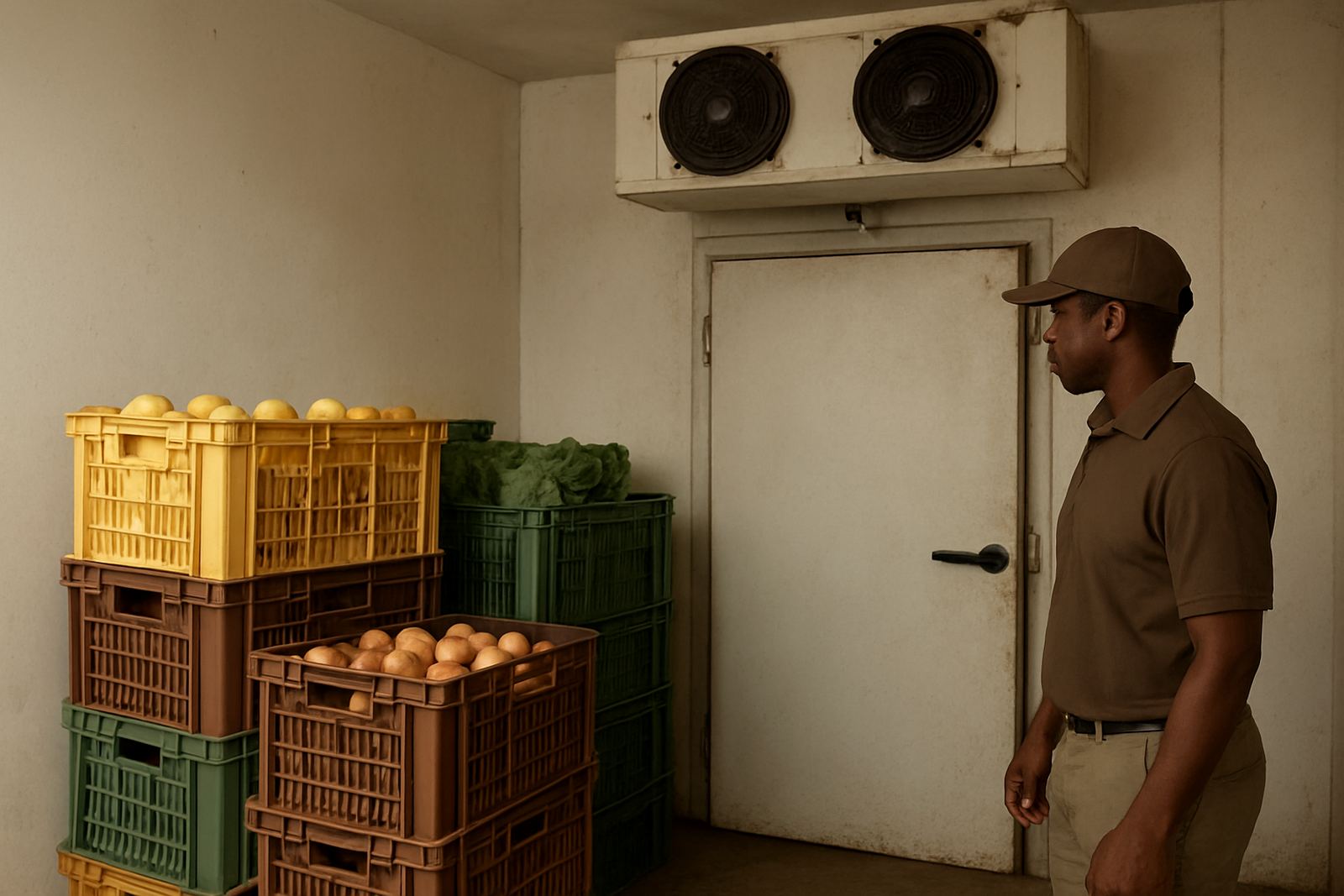
- Cold rooms for stock holding, staging or temperature-sensitive material
- Cooling coils, expansion valves and control panels
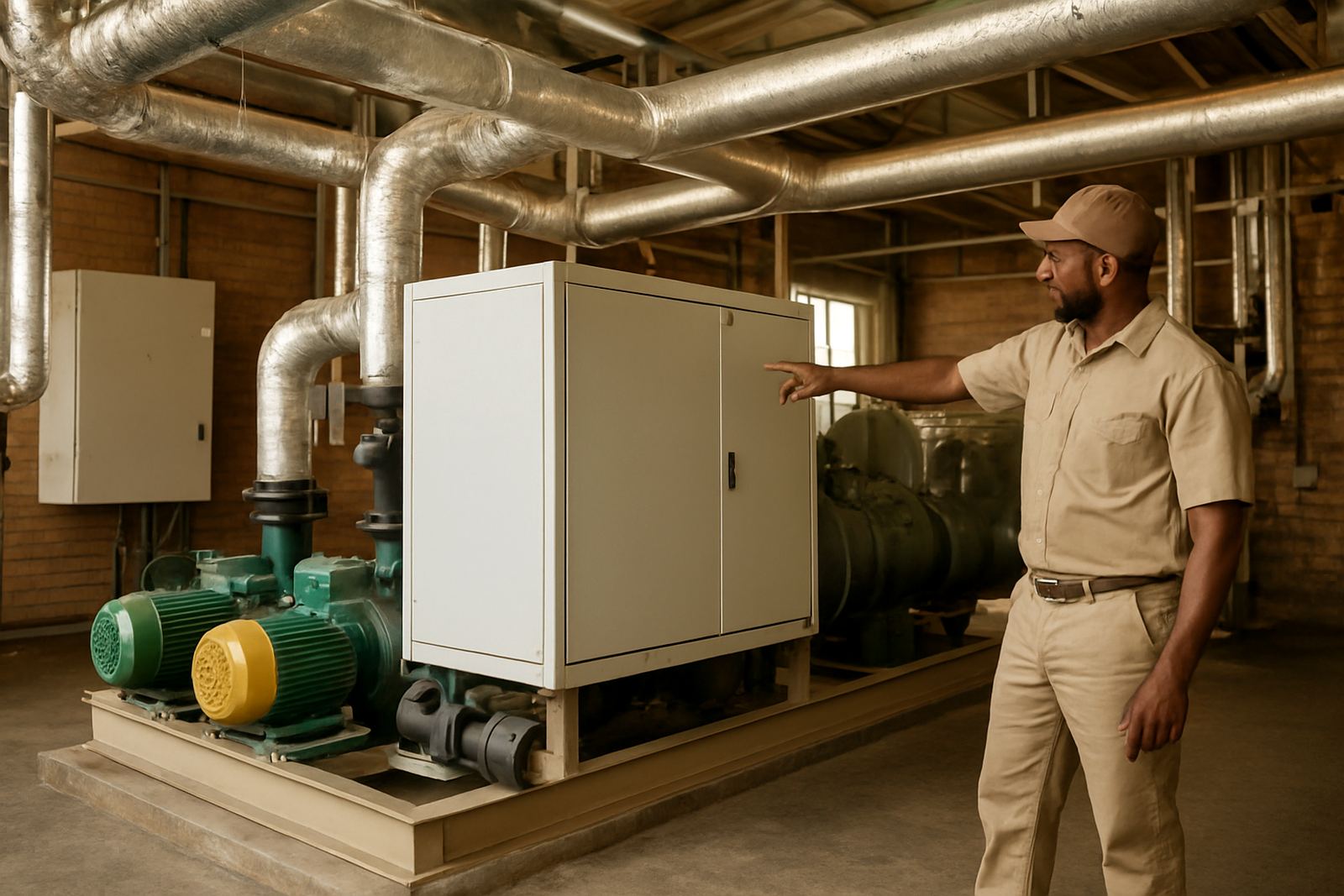
- Pumps, strainers and buffer tanks on process loops
- Temperature monitoring points and alarm systems
- Condenser fans, filters and heat exchange surfaces exposed to dust and salt air
We work across Gqeberha, Port Alfred, Jeffreys Bay and Graaff-Reinet, so we are used to mixed conditions. Coastal humidity can push corrosion faster than expected, while inland sites may deal with dust, heat and voltage variation. That means a factory in the Eastern Cape cannot copy a service plan from somewhere else and hope it holds. The equipment list is only half the story, the site conditions matter just as much.
Layout and planning that make servicing easier
Good factory cooling starts with sensible layout. Units need enough clearance for air movement, safe access for technicians and room to remove panels, motors and coils without shutting half the plant. It sounds basic, but we often arrive at sites where a chiller is boxed into a tight corner, or pipework runs so close to walls that leak checks become awkward and slow.
When we advise on a factory setup, we look at access routes, valve positions, drain points, isolation points and where the monitoring equipment is mounted. If a system needs regular inspection, it should not require ladders in the dark or a forklift moving stock first. If a cold room door is opening all day, the seals, curtains and loading pattern need attention as well, otherwise energy costs creep up fast.
- Leave clear service access around compressors, coils and electrical panels
- Keep sensors away from direct discharge air or false readings will follow
- Plan for isolation valves so maintenance does not stop the full site
- Allow for future capacity if production volumes are likely to grow
- Place monitoring and alarm points where operators can see them quickly
For factories with older pipework or plant rooms, a retrofit plan can be staged. That means we can upgrade controls first, then tackle efficiency items, then convert refrigerant where needed. It spreads cost and reduces risk. Not every site needs a full replacement, and often the safest route is to improve what is already there.
Common mistakes that drive downtime and waste power
The same problems show up again and again in industrial cooling. One is waiting until a breakdown before cleaning coils or checking refrigerant levels. Another is ignoring alarm trends because the system is still running. By the time a unit stops, the extra strain may already have affected production quality or caused hidden damage.
We also see factory teams overloading one unit while another sits underused, or setting temperatures lower than needed in the hope of getting a faster result. That pushes compressors harder and rarely solves the real issue. In some cases the problem is actually airflow, water flow, or a control fault rather than the refrigeration circuit itself. A proper diagnosis saves time and money.
Other common mistakes include poor leak tracking, damaged insulation, loose terminals, dirty strainers and no clear maintenance log. If a site has several shifts, the handover notes matter as much as the hardware. One team may spot a fault and the next team assumes it was already reported. Small gaps like that can become a long outage.
What planned maintenance usually covers
For factory clients, planned maintenance is usually the best value because it keeps the plant visible. Our service plans can be monthly, quarterly or matched to the production cycle. During a visit, we check operating pressures, temperatures, fan condition, controls, leaks, drains, electrical connections and any unusual noise or vibration. We also look at whether the system is still running efficiently for the load it carries.
Depending on the site, this may include coil cleaning, filter changes, temperature monitoring checks and control upgrades. Where low-GWP conversion makes sense, we assess the current refrigerant, the condition of the system and the cost of keeping it compliant over time. If the equipment is still a good mechanical base, a conversion can be a smart way to extend its life without starting from scratch.
For factories in Gqeberha and nearby areas, we keep response planning realistic. If a plant is critical, we recommend spare parts, contact lists and a simple escalation process. The aim is to get the right technician on site with the right parts, not to make the client repeat the same fault report three times.
Budget ranges for factory cooling work in Rand
Factory cooling budgets vary widely because the equipment mix can be very different from one site to the next. A basic inspection and small corrective call-out may start from about R1 500 to R4 500, depending on travel, access and the fault. Planned maintenance visits for a single system usually sit in the R2 500 to R8 000 range, while larger multi-unit sites will need a site-specific schedule.
More involved work costs more because of parts, labour and shutdown planning. Coil cleaning on a heavy-use industrial unit may run from R3 500 to R12 000. Control upgrades, temperature monitoring additions and leak detection projects are often quoted after a site assessment. Low-GWP conversions can range from around R18 000 for smaller systems to well over R80 000 on larger chilled water or process applications. Chiller retrofits for energy savings may start at R25 000 and move upwards depending on controls, pumps and electrical work.
It is worth comparing the cost of repair against the cost of downtime. A factory losing a single production hour can spend far more than the price of a proper service visit. Good maintenance is not the cheapest line on the invoice, but it usually protects the rest of the budget better than emergency work does.